Introduction - VELSON Blast-hole equipment

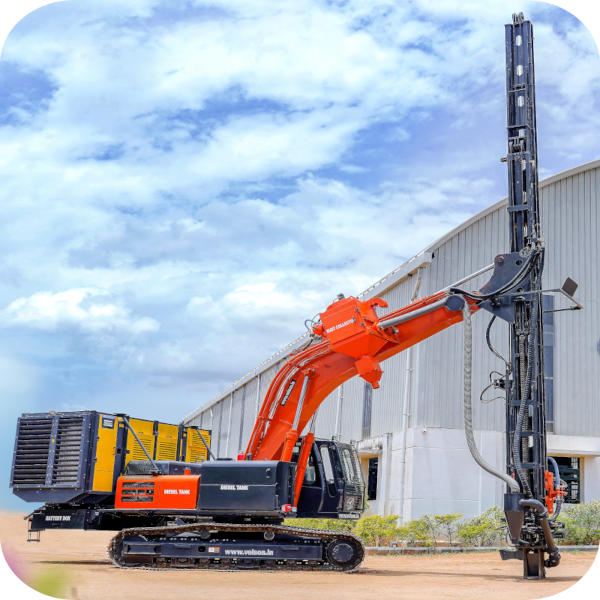
VELSON blast-hole drilling technique thru rig whereby a hole is drilled in the rock surface up to certain depth, and then explosives are loaded to induce cracks on the hard surface of the inner geology formation for further deep drilling. This hole which is meant for loading explosives is known as a blast-hole.
The aim of this technique is to induce cracks in the inner geology of the surrounding rock, in order to facilitate further drilling and associated mining activity.
RAB (Rotary Air Blast) drilling is used frequently for Blast-hole Drilling. In this type of drilling methodology, a piston driven hammer generally pneumatic reciprocating type drives heavy drill bit into the rock with a lot of force. The drill bit is a hollow solid steel material with approximately 20mm thick tungsten rods which hold the drill bits.
The bit blows the rock by applying a feed force to ensure rock/bit contact. Compressed air is used to flush out the slurry, thereby advancing the wellbore depth at an efficient pace.

Excavation and Blast-hole Cycle

Planning

The first step in any mining excavation operation is to plan and survey the land. This allows for the development of a plan that can minimize environmental hazards. This step is of crucial importance for drill and blast mining, since here is where all the calculations around the explosions will be done.

Drilling

Next, blast holes will be drilled into the rock by a drilling rig into the foremost front wall of the tunnel, often called the working face. These holes will be drilled according to the blasting plan developed as an initial step.

Loading

Now that holes have been drilled, the next step is to carefully load them with explosives. Detonators are attached to each explosive, and the explosive devices are also attached to each other. The quantity of explosives needed varies, but harder rocks require more explosives.

Blasting

The holes are blasted sequentially, beginning in the center and then cascading outward. Although there can be hundreds of individual explosions, the entire blast sequence should take no more than a few seconds. It’s important to ensure that the explosives don’t detonate at the same time, but go one after another in specified intervals.

Mucking

Now, it’s time to remove the rock through a process called mucking. Excavators will dislodge any splintered rock that wasn’t completely released by the explosion. Additionally, all the loose rock and rubble will be loaded into dump trucks, either with wheel loaders or conveyor belts.

Securing

Before the process can start all over again, the blasted rock must be secured. Depending on the type of rock, there are a bunch of methods that can be used to secure and stabilize the formation.

Planning

Now that the blasted rock has been secured and is stable, you can then begin the next explosion of the process. Additional calculations and measurements must be made in order to ensure a safe and effective blast. The cycle from planning to securing in drill and blast mining can be repeated multiple times, depending on how big of an extraction operation is needed.
Advantages
  • Drilling and blasting is a very versatile method that can be utilized in all different types of rocks.
  • Drill and blast requires a lower up-front investment than acquiring a TBM, making it a more economically/friendly option.
  • Drilling and blasting is an environmentally friendly option that can significantly reduce noise, dust, and visual pollution, and instead isolates any pollution near the tunnel portal.
  • Compared to cut-and-cover, the quantity of construction & demolition materials (C&D) is greatly reduced.
  • Compared to cut-and-cover, disturbances to local traffic are greatly reduced.
If you and your company are looking for any mining services, you should look and discuss further with VELSON in India.